


"There aren't a lot of new rock acts to choose from if I'm honest"
A New Industry Friday Special: 5 things you should know about the European festival scene in 2024
Happy… Tuesday?
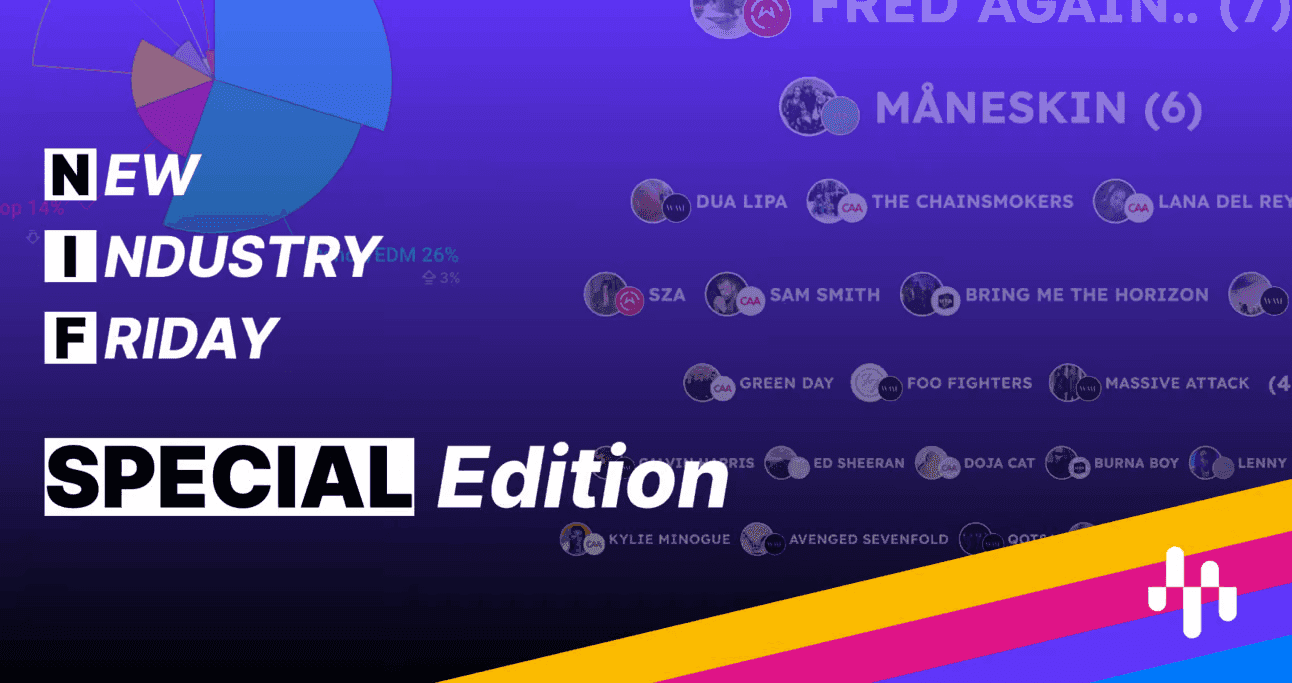
This is the first special edition of New Industry Friday.
NIF specials dive deeper into music industry topics we think you'll find interesting; exclusive data, interviews, profiles, analysis, and more.
5 things you should know about the European festival scene in 2024
For the past 2 years, NIF's parent company ROSTR has collaborated with our friends at IQ Mag to analyze the European festival summer.
IQ select 50 of the top European festivals and we then use ROSTR data to analyze the lineups together.
These are 5 of the most interesting trends from this year's data…
1. The beginning of the end for Rock/Indie headliner dominance?
"There aren't a lot of new rock acts to choose from if I'm honest."
That's what Glastonbury Festival's Emily Eavis said about the lack of rock acts headlining the festival in 2024. But it wasn't just Emily, and it wasn't just Glastonbury…
Across the 50 festivals we analyzed, the share of headliners we classify as Rock/Indie dropped from 43% last year to 30% this year. A 30% year-on-year decline.
What filled the gap? A mix: Hip Hop's share doubled year-on-year to 14%. Metal, R&B/soul, Country, K-Pop also grew. Pop was pretty much flat (down 1%).
But, the big story here is the continuing trend towards decks over guitars. This year there were almost as many Dance/EDM headliners (26%) as Rock/Indie headliners (30%).
Could 2025 be the year that dance flips rock? And if so, what does that mean for how festivals might need to change?
2. It's not just you, Fred again.. was actually everywhere
Personifying that Dance/EDM trend was British DJ/Producer Fred again.. who headlined 7 out of the 50 festivals we tracked.
Italian rock band Måneskin were next up with 6 headlines, followed by Dua Lipa, The Chainsmokers, and Lana Del Rey (5 each).
Outside of the headliners, Kenya Grace was the most booked artist, appearing at 11 of 50 festivals. Nothing But Thieves, the most booked artist last year, were 2nd most booked this year with 10.
3. Gender balance, what gender balance?
Of the approximately 5,000 artists across the 50 lineups, 69% were men. Incredulously, that figure actually increased by 5% vs last year.
Just 22% of artists were women - under a quarter. Non-binary artists made up less than 1%.
For headliners, it somehow gets worse…
78% of solo headliners were men - nearly 4 in 5. This feels especially egregious given we're in an era where solo female acts are dominating not just the charts, but culture too.
Oh, but it can still get worse again…
We also analyzed the members of headlining groups. Just 3% of them were women. Yes, you read that right - three percent.
Which means that across both solo and groups, 92% of every human on stage during a headline set was a man 🤦♂️.
Shout out to BST Hyde Park (56% female artists), Way Out West (46%), and Roskilde (41%), which were the most balanced lineups. 5 of the top 10 most balanced festivals were in the Nordics.
4. SOME GOOD NEWS: Headliners got younger…
… by 1 year.
The average age of headliners was down from 43 last year to 42 this year.
But, if you look at the funnel image below you'll see that there was a squeeze toward the "middle". Yes, there were fewer of the 4 and 5 decade career artists, but there was no increase in the top of the funnel (the artists in the first couple of decades of their career).
Festivals, and the industry more generally, have been concerned about the "headliner pipeline" problem for some time - that is, whether enough future headliners are being produced. Combined with other festival pressures, it looks like this is really coming to a head now.
5. Just 5 agencies booked 75% of all the artists
The 4 major agencies (Wasserman, WME, CAA & UTA) plus UK-based ATC Live booked 75% of all the artists across all 50 lineups.
Wasserman Music, who have the largest agency roster in the world (2,616 artists), booked the most artists overall. But O.G. Hollywood royalty still dominate the headline bookings; CAA with the most, followed by WME.
Wild stat: ATC Live were the only independent agency to book a solo female headliner 🤯.
Related stat: a couple of years ago we did some analysis that showed that fewer than a quarter of artists signed to the top 100 agencies in the world were female.
BONUS: Analysis
At the International Festival Forum in London last month, one panelist described 2024 as "the worst year ever for European festivals (outside of the pandemic)". And, it's not just Europe. Coachella '24 didn't sell out. Australia and other markets saw record cancellations.
Will Page, an economist (and a friend) wrote this piece laying out some of the reasons for this down-turn.
Some additional thoughts based on this data:
a) Dependence on legacy headliners:
Relying on headliners whose careers began before much of the potential audience was even born is less than ideal. With rising costs and increasing ticket prices, festivals need to attract attendees with deeper pockets which often means older audiences who want… older artists… who are then less attractive to new audiences. Vicious cycle.
b) Fans know (and want) what they want
Aiming for more representative lineups isn't just some "woke thing" - it's a consumer thing. Fans today have so much choice and awareness. Woefully imbalanced lineups that fail to reflect the diversity of the audience and current music trends risk writing off large sections of potential attendees.
c) From star headliners to direct competition
This year, many of the superstars who might have previously headlined festivals (Taylor, Beyoncé, Adele etc) opted for highly lucrative solo plays instead. Festivals are not only missing out on the star-power that drives ticket sales but also find themselves competing with these tours for consumer spending in increasingly tight economies.
If It looks like it's going to be a challenging few years for the festival scene. But let's hope calling 2024 "the year the music festival died" is premature.
p.s. IQ's full report of the data is in IQ 130
Happy… Tuesday?
This is the first special edition of New Industry Friday.
NIF specials dive deeper into music industry topics we think you'll find interesting; exclusive data, interviews, profiles, analysis, and more.
5 things you should know about the European festival scene in 2024
For the past 2 years, NIF's parent company ROSTR has collaborated with our friends at IQ Mag to analyze the European festival summer.
IQ select 50 of the top European festivals and we then use ROSTR data to analyze the lineups together.
These are 5 of the most interesting trends from this year's data…
1. The beginning of the end for Rock/Indie headliner dominance?
"There aren't a lot of new rock acts to choose from if I'm honest."
That's what Glastonbury Festival's Emily Eavis said about the lack of rock acts headlining the festival in 2024. But it wasn't just Emily, and it wasn't just Glastonbury…
Across the 50 festivals we analyzed, the share of headliners we classify as Rock/Indie dropped from 43% last year to 30% this year. A 30% year-on-year decline.
What filled the gap? A mix: Hip Hop's share doubled year-on-year to 14%. Metal, R&B/soul, Country, K-Pop also grew. Pop was pretty much flat (down 1%).
But, the big story here is the continuing trend towards decks over guitars. This year there were almost as many Dance/EDM headliners (26%) as Rock/Indie headliners (30%).
Could 2025 be the year that dance flips rock? And if so, what does that mean for how festivals might need to change?
2. It's not just you, Fred again.. was actually everywhere
Personifying that Dance/EDM trend was British DJ/Producer Fred again.. who headlined 7 out of the 50 festivals we tracked.
Italian rock band Måneskin were next up with 6 headlines, followed by Dua Lipa, The Chainsmokers, and Lana Del Rey (5 each).
Outside of the headliners, Kenya Grace was the most booked artist, appearing at 11 of 50 festivals. Nothing But Thieves, the most booked artist last year, were 2nd most booked this year with 10.
3. Gender balance, what gender balance?
Of the approximately 5,000 artists across the 50 lineups, 69% were men. Incredulously, that figure actually increased by 5% vs last year.
Just 22% of artists were women - under a quarter. Non-binary artists made up less than 1%.
For headliners, it somehow gets worse…
78% of solo headliners were men - nearly 4 in 5. This feels especially egregious given we're in an era where solo female acts are dominating not just the charts, but culture too.
Oh, but it can still get worse again…
We also analyzed the members of headlining groups. Just 3% of them were women. Yes, you read that right - three percent.
Which means that across both solo and groups, 92% of every human on stage during a headline set was a man 🤦♂️.
Shout out to BST Hyde Park (56% female artists), Way Out West (46%), and Roskilde (41%), which were the most balanced lineups. 5 of the top 10 most balanced festivals were in the Nordics.
4. SOME GOOD NEWS: Headliners got younger…
… by 1 year.
The average age of headliners was down from 43 last year to 42 this year.
But, if you look at the funnel image below you'll see that there was a squeeze toward the "middle". Yes, there were fewer of the 4 and 5 decade career artists, but there was no increase in the top of the funnel (the artists in the first couple of decades of their career).
Festivals, and the industry more generally, have been concerned about the "headliner pipeline" problem for some time - that is, whether enough future headliners are being produced. Combined with other festival pressures, it looks like this is really coming to a head now.
5. Just 5 agencies booked 75% of all the artists
The 4 major agencies (Wasserman, WME, CAA & UTA) plus UK-based ATC Live booked 75% of all the artists across all 50 lineups.
Wasserman Music, who have the largest agency roster in the world (2,616 artists), booked the most artists overall. But O.G. Hollywood royalty still dominate the headline bookings; CAA with the most, followed by WME.
Wild stat: ATC Live were the only independent agency to book a solo female headliner 🤯.
Related stat: a couple of years ago we did some analysis that showed that fewer than a quarter of artists signed to the top 100 agencies in the world were female.
BONUS: Analysis
At the International Festival Forum in London last month, one panelist described 2024 as "the worst year ever for European festivals (outside of the pandemic)". And, it's not just Europe. Coachella '24 didn't sell out. Australia and other markets saw record cancellations.
Will Page, an economist (and a friend) wrote this piece laying out some of the reasons for this down-turn.
Some additional thoughts based on this data:
a) Dependence on legacy headliners:
Relying on headliners whose careers began before much of the potential audience was even born is less than ideal. With rising costs and increasing ticket prices, festivals need to attract attendees with deeper pockets which often means older audiences who want… older artists… who are then less attractive to new audiences. Vicious cycle.
b) Fans know (and want) what they want
Aiming for more representative lineups isn't just some "woke thing" - it's a consumer thing. Fans today have so much choice and awareness. Woefully imbalanced lineups that fail to reflect the diversity of the audience and current music trends risk writing off large sections of potential attendees.
c) From star headliners to direct competition
This year, many of the superstars who might have previously headlined festivals (Taylor, Beyoncé, Adele etc) opted for highly lucrative solo plays instead. Festivals are not only missing out on the star-power that drives ticket sales but also find themselves competing with these tours for consumer spending in increasingly tight economies.
If It looks like it's going to be a challenging few years for the festival scene. But let's hope calling 2024 "the year the music festival died" is premature.
p.s. IQ's full report of the data is in IQ 130
Happy… Tuesday?
This is the first special edition of New Industry Friday.
NIF specials dive deeper into music industry topics we think you'll find interesting; exclusive data, interviews, profiles, analysis, and more.
5 things you should know about the European festival scene in 2024
For the past 2 years, NIF's parent company ROSTR has collaborated with our friends at IQ Mag to analyze the European festival summer.
IQ select 50 of the top European festivals and we then use ROSTR data to analyze the lineups together.
These are 5 of the most interesting trends from this year's data…
1. The beginning of the end for Rock/Indie headliner dominance?
"There aren't a lot of new rock acts to choose from if I'm honest."
That's what Glastonbury Festival's Emily Eavis said about the lack of rock acts headlining the festival in 2024. But it wasn't just Emily, and it wasn't just Glastonbury…
Across the 50 festivals we analyzed, the share of headliners we classify as Rock/Indie dropped from 43% last year to 30% this year. A 30% year-on-year decline.
What filled the gap? A mix: Hip Hop's share doubled year-on-year to 14%. Metal, R&B/soul, Country, K-Pop also grew. Pop was pretty much flat (down 1%).
But, the big story here is the continuing trend towards decks over guitars. This year there were almost as many Dance/EDM headliners (26%) as Rock/Indie headliners (30%).
Could 2025 be the year that dance flips rock? And if so, what does that mean for how festivals might need to change?
2. It's not just you, Fred again.. was actually everywhere
Personifying that Dance/EDM trend was British DJ/Producer Fred again.. who headlined 7 out of the 50 festivals we tracked.
Italian rock band Måneskin were next up with 6 headlines, followed by Dua Lipa, The Chainsmokers, and Lana Del Rey (5 each).
Outside of the headliners, Kenya Grace was the most booked artist, appearing at 11 of 50 festivals. Nothing But Thieves, the most booked artist last year, were 2nd most booked this year with 10.
3. Gender balance, what gender balance?
Of the approximately 5,000 artists across the 50 lineups, 69% were men. Incredulously, that figure actually increased by 5% vs last year.
Just 22% of artists were women - under a quarter. Non-binary artists made up less than 1%.
For headliners, it somehow gets worse…
78% of solo headliners were men - nearly 4 in 5. This feels especially egregious given we're in an era where solo female acts are dominating not just the charts, but culture too.
Oh, but it can still get worse again…
We also analyzed the members of headlining groups. Just 3% of them were women. Yes, you read that right - three percent.
Which means that across both solo and groups, 92% of every human on stage during a headline set was a man 🤦♂️.
Shout out to BST Hyde Park (56% female artists), Way Out West (46%), and Roskilde (41%), which were the most balanced lineups. 5 of the top 10 most balanced festivals were in the Nordics.
4. SOME GOOD NEWS: Headliners got younger…
… by 1 year.
The average age of headliners was down from 43 last year to 42 this year.
But, if you look at the funnel image below you'll see that there was a squeeze toward the "middle". Yes, there were fewer of the 4 and 5 decade career artists, but there was no increase in the top of the funnel (the artists in the first couple of decades of their career).
Festivals, and the industry more generally, have been concerned about the "headliner pipeline" problem for some time - that is, whether enough future headliners are being produced. Combined with other festival pressures, it looks like this is really coming to a head now.
5. Just 5 agencies booked 75% of all the artists
The 4 major agencies (Wasserman, WME, CAA & UTA) plus UK-based ATC Live booked 75% of all the artists across all 50 lineups.
Wasserman Music, who have the largest agency roster in the world (2,616 artists), booked the most artists overall. But O.G. Hollywood royalty still dominate the headline bookings; CAA with the most, followed by WME.
Wild stat: ATC Live were the only independent agency to book a solo female headliner 🤯.
Related stat: a couple of years ago we did some analysis that showed that fewer than a quarter of artists signed to the top 100 agencies in the world were female.
BONUS: Analysis
At the International Festival Forum in London last month, one panelist described 2024 as "the worst year ever for European festivals (outside of the pandemic)". And, it's not just Europe. Coachella '24 didn't sell out. Australia and other markets saw record cancellations.
Will Page, an economist (and a friend) wrote this piece laying out some of the reasons for this down-turn.
Some additional thoughts based on this data:
a) Dependence on legacy headliners:
Relying on headliners whose careers began before much of the potential audience was even born is less than ideal. With rising costs and increasing ticket prices, festivals need to attract attendees with deeper pockets which often means older audiences who want… older artists… who are then less attractive to new audiences. Vicious cycle.
b) Fans know (and want) what they want
Aiming for more representative lineups isn't just some "woke thing" - it's a consumer thing. Fans today have so much choice and awareness. Woefully imbalanced lineups that fail to reflect the diversity of the audience and current music trends risk writing off large sections of potential attendees.
c) From star headliners to direct competition
This year, many of the superstars who might have previously headlined festivals (Taylor, Beyoncé, Adele etc) opted for highly lucrative solo plays instead. Festivals are not only missing out on the star-power that drives ticket sales but also find themselves competing with these tours for consumer spending in increasingly tight economies.
If It looks like it's going to be a challenging few years for the festival scene. But let's hope calling 2024 "the year the music festival died" is premature.
p.s. IQ's full report of the data is in IQ 130
Fred again..
Måneskin
Dua Lipa
The Chainsmokers
Lana Del Rey
Kenya Grace
Nothing But Thieves
Emily Eavis
Wasserman Music
WME
UTA
ATC Live
Will Page
Creative Artists Agency (CAA)
European Festival Trends
Festival Headliner Pipeline
Gender Balance In Music
Agency Market Share
Festival Analytics
Lineup Demographics
Talent Agencies
Venue Economics
Italy
United States
United Kingdom
Australia
London, GB
👋 Disclosures & Transparency Block
This is one of NIF's newsletters. News and other editorial are selected by the team based on which news they think is interesting (or funny) this week.
📨 Subscribe to NIF
Get news dropped in your inbox 👇
📨 Subscribe to NIF
Get news dropped in your inbox 👇
Related Articles

Culture & Lifestyle
Feb 13, 2026
1 min read
Vol 65 - I can't escape the story you gave me, constant reading in my brains
UMG goes Downtown, this is what tours are made of & "We were going to get this done for Bad Bunny no matter what” - guy who played a chunk of grass 🌱🌿

Culture & Lifestyle
Feb 11, 2026
1 min read
Music Collectibles Platform Wax Poetics Raises $1 Million
It recently sold an early Mariah Carey demo tape for $54,050

Culture & Lifestyle
Feb 10, 2026
1 min read
Discogs Launches ‘My Discography’ Documentary Series
Each episode spotlights a collector and their stories

Vol 65 - I can't escape the story you gave me, constant reading in my brains
UMG goes Downtown, this is what tours are made of & "We were going to get this done for Bad Bunny no matter what” - guy who played a chunk of grass 🌱🌿

The NIF Team
Culture
Feb 13, 2026

Music Collectibles Platform Wax Poetics Raises $1 Million
It recently sold an early Mariah Carey demo tape for $54,050

Rod Yates
Culture
Feb 11, 2026

Discogs Launches ‘My Discography’ Documentary Series
Each episode spotlights a collector and their stories

Rod Yates
Culture
Feb 10, 2026

Too Long; Did Read - February 2026
Breaking down recommendations for February including the books, podcasts, interviews, music and more you should know about

Katie Holmes
Culture
Feb 6, 2026

Vol 64 - We sit on the fire escape, We write and read 'til dawn
GRAMMYs recap, Bad Bunny Bowl & Shakira’s tour numbers don’t lie.

The NIF Team
Culture
Feb 6, 2026

Bad Bunny Partners with iHeartMedia to Produce Podcasts on Latino-Centered Channel, My Cultura
The first podcast will be hosted by MLB player Ronald Acuña Jr.

Harry Levin
Culture
Feb 5, 2026