
The Data Behind The 2026 GRAMMY Awards

An analysis of the industry and trends behind the GRAMMY nominees – Best New Artists are slightly newer. UMG dominate (again). Gender balance slips.

This is a guest post by Mark Williamson (CEO) and George Hanson (Head of Data) at The ROSTR Group (which owns and operates New Industry Focus). This is an independent analysis with no affiliation to the GRAMMY Awards.

For better or worse, the GRAMMYs are an annual snapshot of what's happening across the industry. Each year we use data from ROSTR to help understand the industry and data trends behind the year's nominees.

Coming up in this article…

  • Best New Artist is actually younger this year

  • UMG still lead, WMG step up, indies hold their ground

  • Management spreads out while agencies bunch together at the top

  • Gender balance tilts back towards men, with one first

⚠️ Read this first

We’ve focused again on 26 GRAMMY categories – the big general field awards and a set of mainstream genre categories. It’s a sample of the ballot, not every single category, but it gives a decent picture of what's happening behind the scenes. Read more about our methodology behind this analysis in our transparency block at the bottom.

Best New Artist: actually a bit new(er) this year

The Recording Academy defines Best New Artist around “breakthrough into the public consciousness.” In practice, that’s rarely a first‑or‑second‑release moment anymore. Last year, the average gap between a BNA nominee’s debut and their nomination was 7.8 years – a stat that went viral when we shared it on socials.

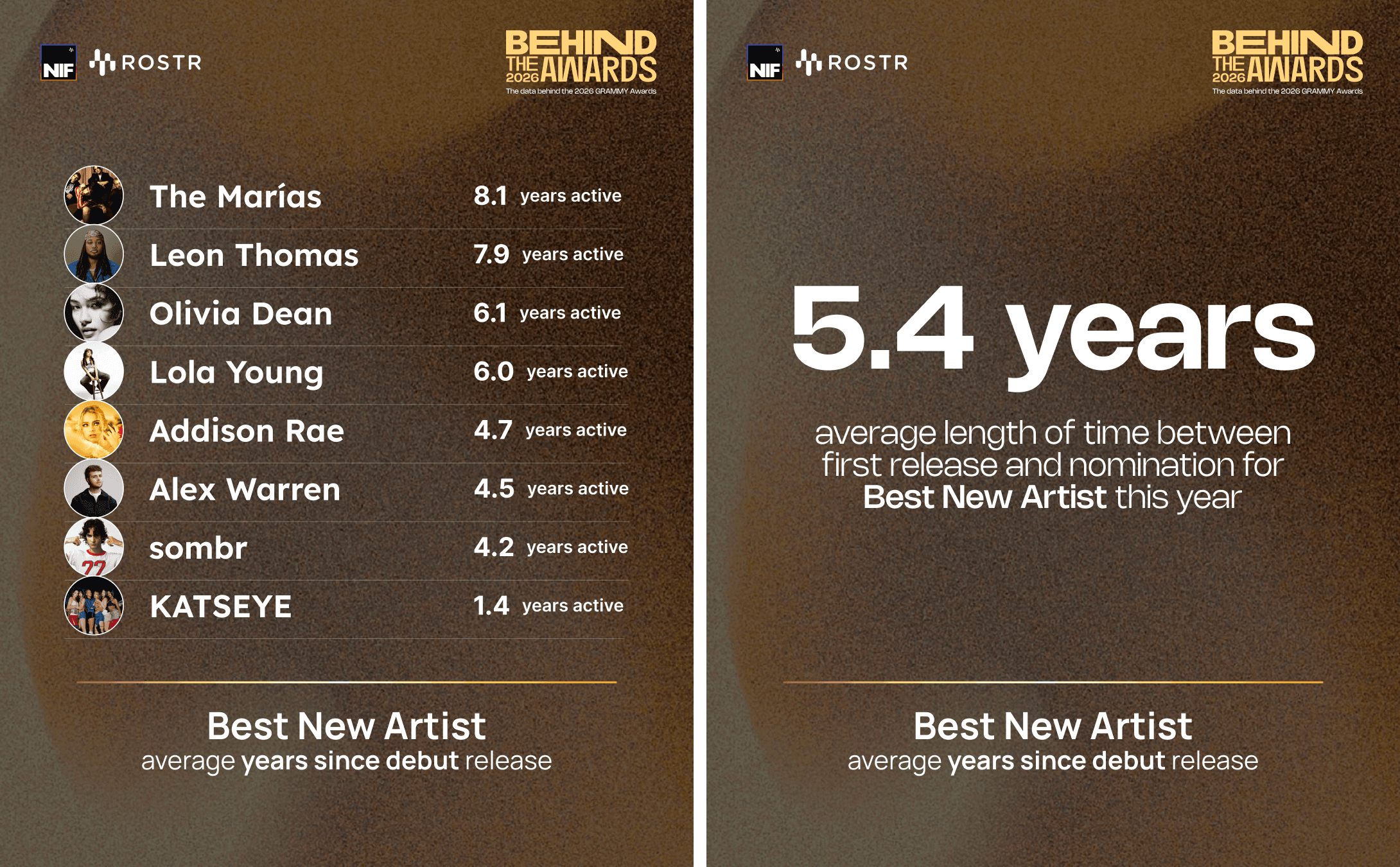
This year, that figure drops significantly to 5.4 years, the shortest average in three years. 2026's Best New Artist nominees are newer than they have been in a while.
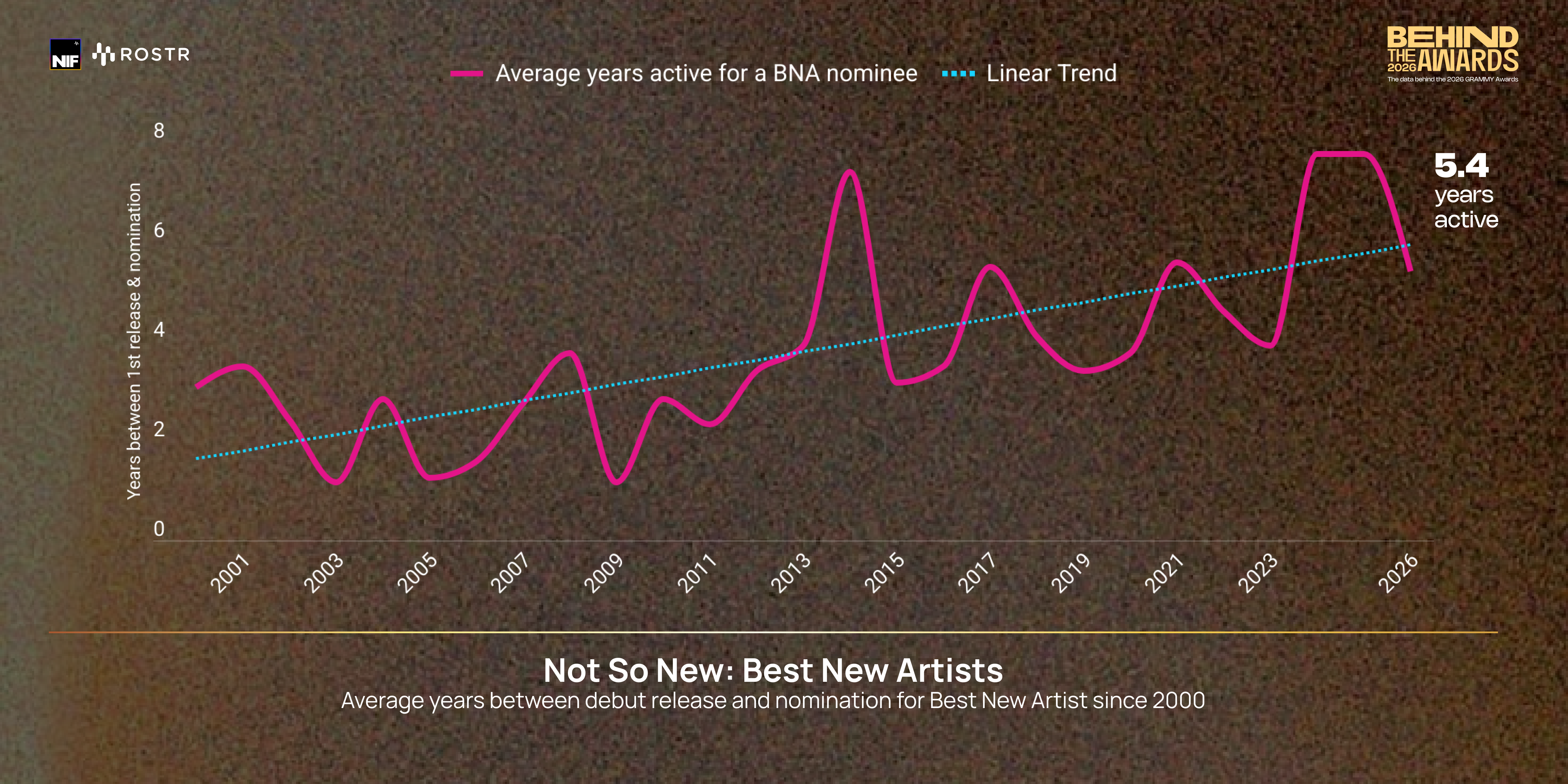
The average number of years since first release for Best New Artist nominees since 2000 (pink line) plotted against the linear trend (blue line)

Here’s the 2026 field and roughly how long they’ve been releasing music:

  • The Marías – 8.1 years

  • Leon Thomas – 7.9

  • Olivia Dean – 6.1

  • Lola Young – 6.0

  • Addison Rae – 4.7

  • Alex Warren – 4.5

  • sombr – 4.2

  • KATSEYE – 1.4

While the average is down significantly this year, it's still well above the 2000s when Best New Artist nominees averaged just over 2 years from debut. It's not a coincidence that the sharp rise in the average coincides with the rise of streaming in the 2010s where it's taking longer for artists to breakthrough in a more competitive global market. Critics have argued the category should really be called “Best Breakthrough Artist,” and the numbers back that up.
The Major Labels: UMG still dominates, WMG pulls ahead of Sony

Across our 26 categories, UMG take 42% of all nominations, down from 50% last year. Independents stay steady at 23% (22% in 2025). WMG jump to 19% from 11%, while Sony's share drops slightly to 16% (from 17% LY).

Looking at unique artists instead of raw nominations:

  • UMG – 35% of nominated artists

  • Independents – 26%

  • WMG – 20%

  • Sony – 19%

UMG still have a clear lead, but WMG’s rise is interesting. In most of the datasets we’ve published over the last few years, they’ve been behind both UMG and Sony. This year they edge ahead of Sony on both nominations and artists and close a chunk of the distance to UMG.

Whether that’s early evidence of the company’s re‑tooling paying off or just one of those GRAMMY‑cycle quirks is a question for another day, but the chart doesn’t look like every other year we’ve run it.
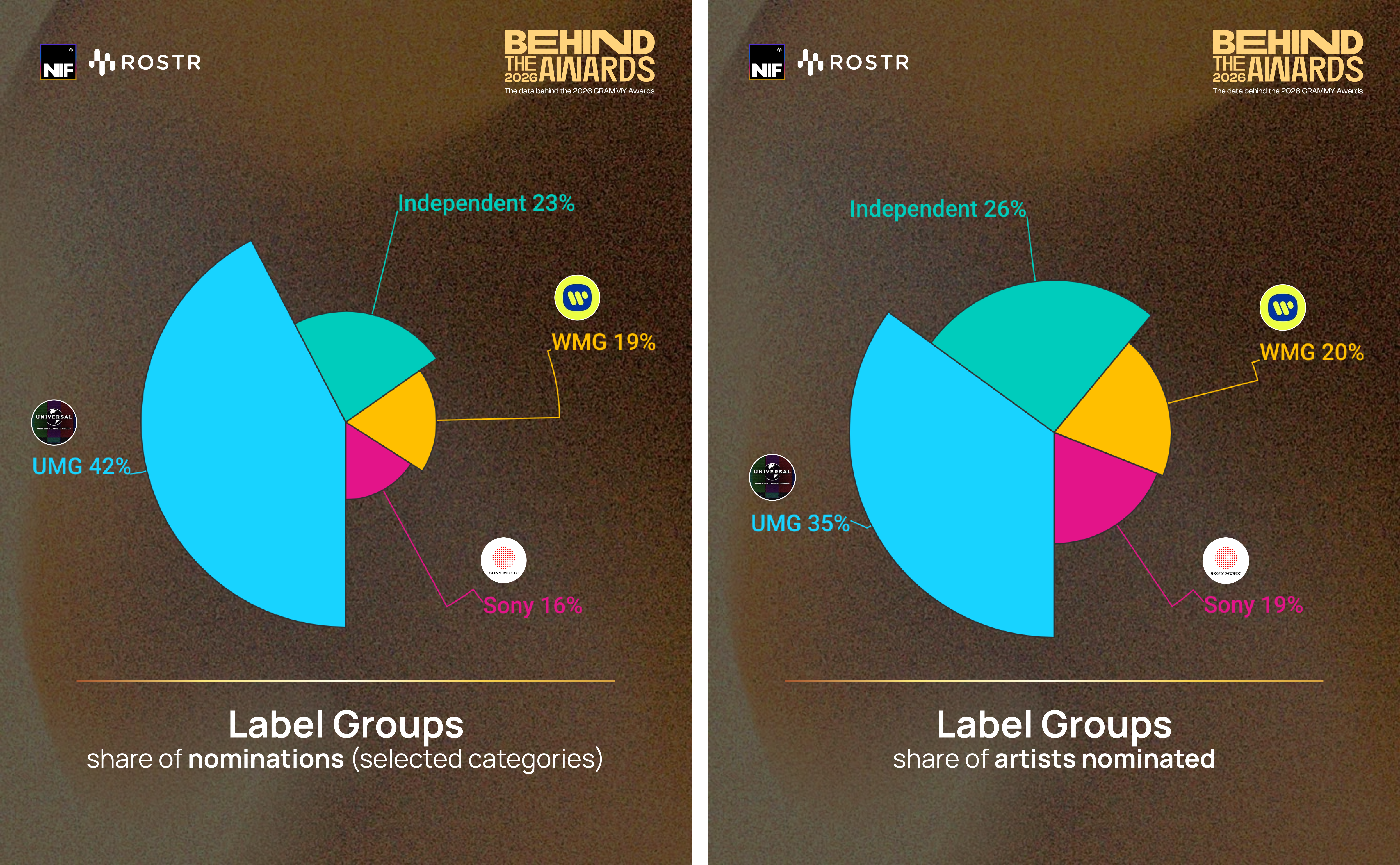
(Left) Share of total nominations by label group
(Right) Share of unique artists nominated by label group

Zooming in on Best New Artist, Album of the Year and Record of the Year, UMG continue to stack up the nominations. Out of 25 total slots across those three categories, UMG take 1560% of the total.

The rest:

  • WMG – 4 nominations

  • Independents – 4

  • Sony – 2

That means independents outscore one of the majors (Sony) in the marquee categories for the first time since 2022, and only the ninth time since 2000.

This lines up with another report we published recently showing independents had a strong showing on this year's Coachella lineup.
The cumulative number of nominations across 3 major awards - BNA, AOTY, ROTY and broken down by the major label groups

Label Imprints: Interscope repeat, Atlantic have a strong year

Given UMG’s share, it’s no surprise their labels dominate the rankings again. Interscope once again top the rankings, but a notably strong year for Atlantic is a big part of why WMG have increased their share this year.

Top labels by total nominations this year:

  1. Interscope Records22 nominations / 11 artists

  2. Atlantic Records11 / 8

  3. Island Records10 / 4

  4. RCA Records9 / 5

  5. Capitol Records8 / 3

  6. Columbia Records8 / 4

  7. Def Jam Recordings6 / 3

  8. pgLang6 / 1

  9. EZMNY Records5 / 1

  10. Motown Records5 / 1

  11. Roadrunner Records5 / 1

  12. Warner Records UK5 / 3

For the first time in this run, two independent labels sneak into the top 10 by nominations – pgLang and EZMNY Records. But, it's important to note that both of those indies appear via co‑releases with majors: pgLang with Interscope, EZMNY with Motown. And both are thanks to one artist each – Kendrick Lamar & Leon Thomas.
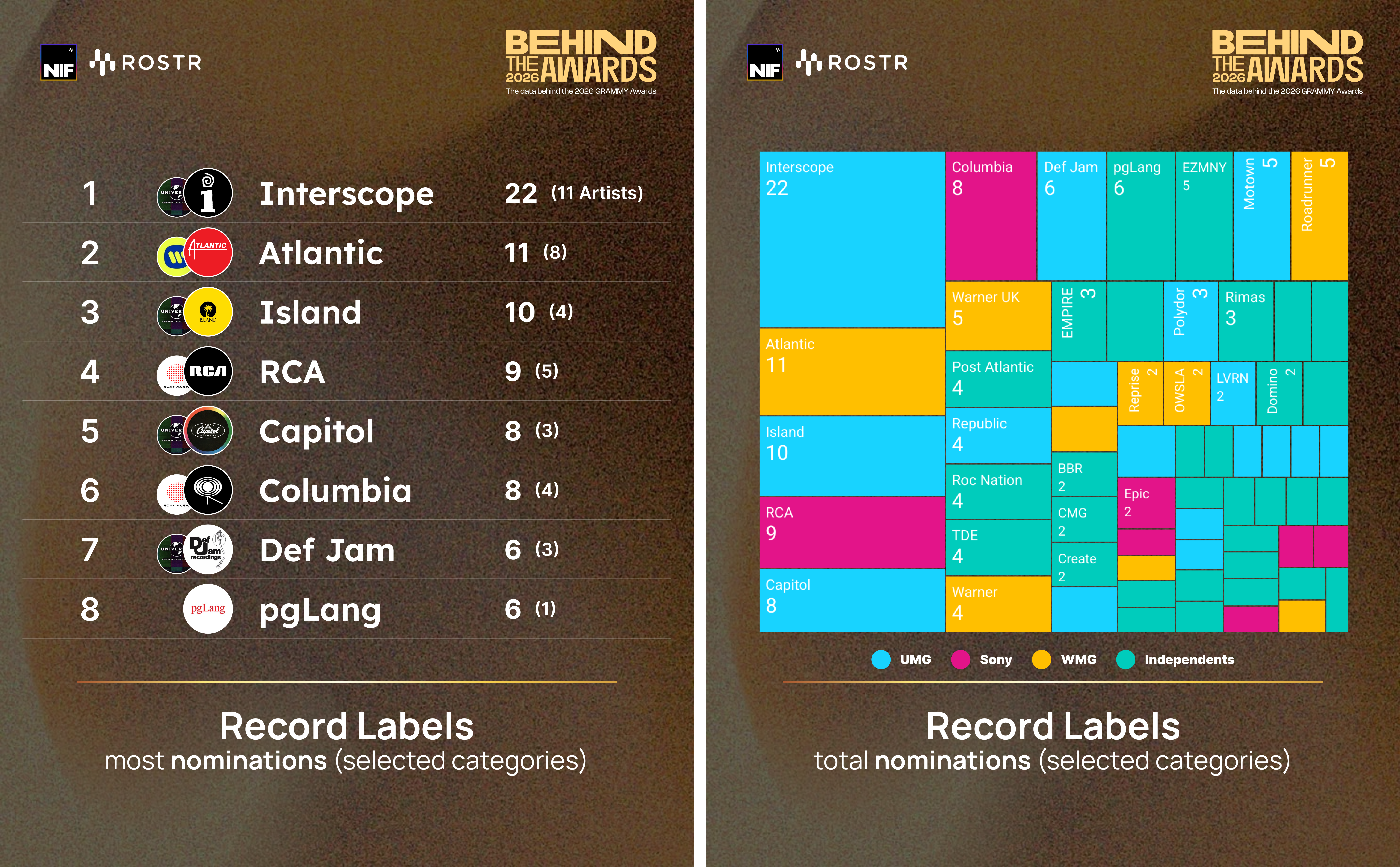
(Left) The top 10 labels by total number of nominations
(Right) All labels sized by the share of nominations they received, color coded by label group

Management: the load spreads out

Last year, management was top‑heavy. Red Light alone had 13 nominations across 6 artists, with Good World on 9 and State of the Art on 8. This year the nominees are a little more spread out at the top.

⚠️ A reminder that these counts are only for the 26 mainstream categories we analyzed. For a full list of nominations by company check out the NIF & ROSTR Voter Guide.

Top management companies by total nominations:

  1. Artist Nation6 nominations / 1 artist

  2. Emagen Entertainment Group6 / 1

  3. Volara6 / 2

  4. pgLang6 / 1

  5. Red Light Management5 / 3

  6. 4 Strikes5 / 1

  7. Gold Theory5 / 1

  8. Culture Collective5 / 1

  9. Bieber Family Office4 / 1

  10. By The Way4 / 4

  11. Fly South Music Group4 / 1

  12. Goodlife Management4 / 2

  13. Habibi4 / 2

  14. Top Dawg Entertainment (TDE)4 / 2

  15. Full Stop Management - 3 / 3

As we've published in various reports before, the management world is fundamentally fragmented. Even Red Light, who have the largest management roster in the world with 500+ artists, have just 3 artists nominated across these 26 categories. Only a handful of other companies have more than 1 artist in the running.
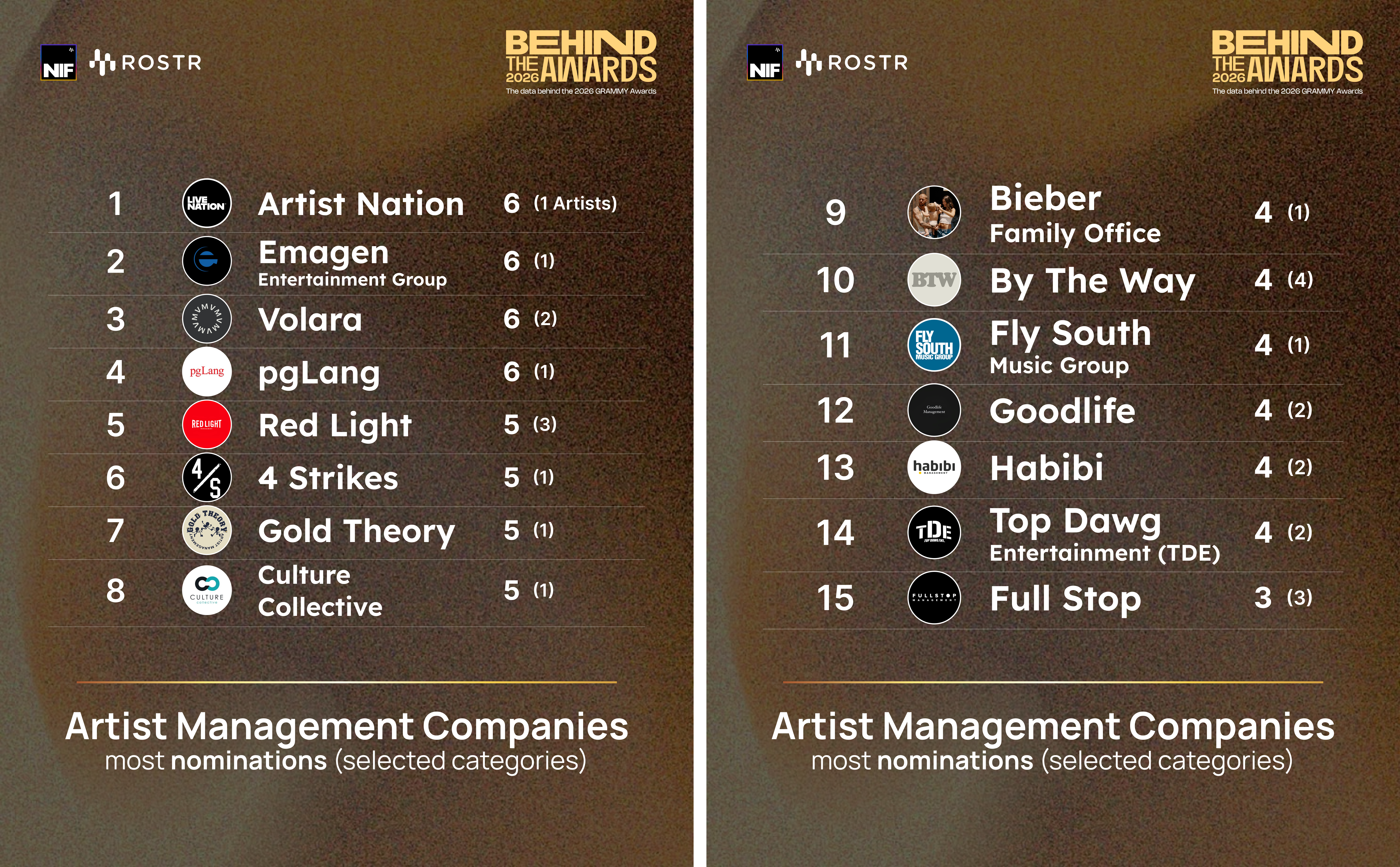
The top 15 management companies based on total nominations
ⓘ When an artist is repped by multiple companies, we count that nomination for each company

Agencies: Wasserman’s jump, UTA’s surge

If management is spreading out, booking is doing the opposite.

Across our sample, the four major agencies – CAA, Wasserman, UTA, WME – now represent 85% of all nominations and 84% of nominated artists across these 26 categories. Last year those numbers were 75% and 70%.

The table this year:

  1. Wasserman Music51 nominations / 27 artists

  2. CAA38 / 22

  3. UTA33 / 20

  4. WME23 / 17

  5. IAG6 / 5

  6. Set Me Free Music4 / 2

  7. Supersonic Australasia3 / 2

  8. Primary Talent2 / 1
    9–18. A long tail of single‑nomination agencies.

This is a flip from 2025, when CAA led with 57 nominations and 24 artists, Wasserman sat on 35/19, and WME had 33/20.

The two big moves:

  • Wasserman swap places with CAA and add 16 represented nominations year‑on‑year.

  • UTA almost triple their total connected nominations (13 → 33) and more than double the number of nominated artists they represent in 2026 (8 → 20).
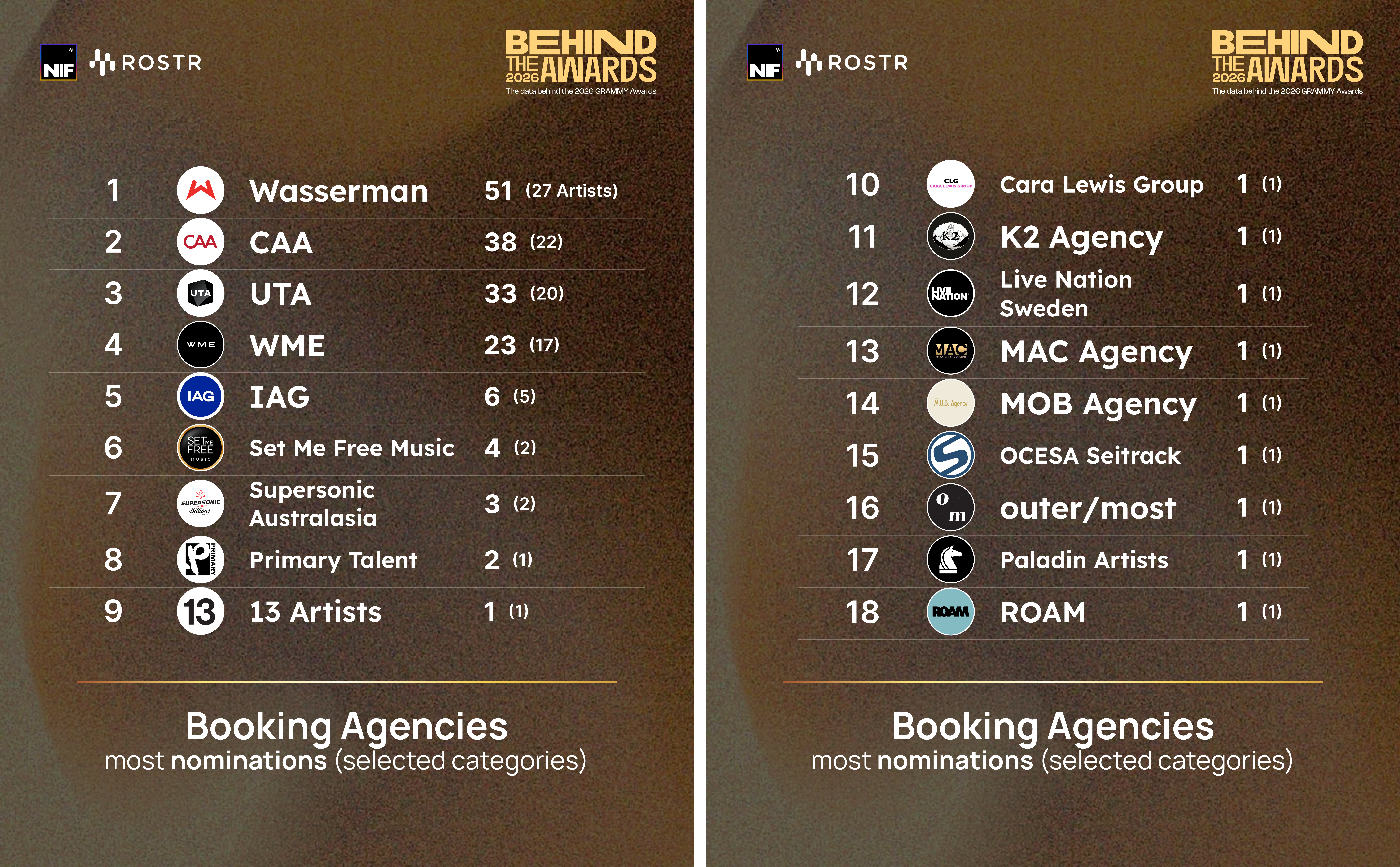
All booking agencies with at least 1 nomination
ⓘ When an artist is repped by multiple agencies, we count that nomination for each agency regardless of territory

Gender: the balance tips back

Last year we saw a rare near‑split across the 26 awards in this analysis: 50.5% of nominees were male, 48.2% were female, and mixed groups made up the rest. None of the artists in those categories publicly identified as non‑binary.

This year the balance slips back:

  • Male: 78 nominations55%

  • Female: 5438%

  • Mixed: 96%

  • Non‑binary: 1<1%

So we lose some of last year’s balance between men and women, but we see more mixed‑gender acts and the first non‑binary nominee in the set of categories we analyze.

The category‑level picture is familiar. In 2025, Album, Record and Song of the Year skewed heavily female, while Rap, Rock and Dance/Electronic albums were almost entirely male. That pattern doesn’t vanish in a single year, and you can see it in the updated chart, even as the overall share shifts.
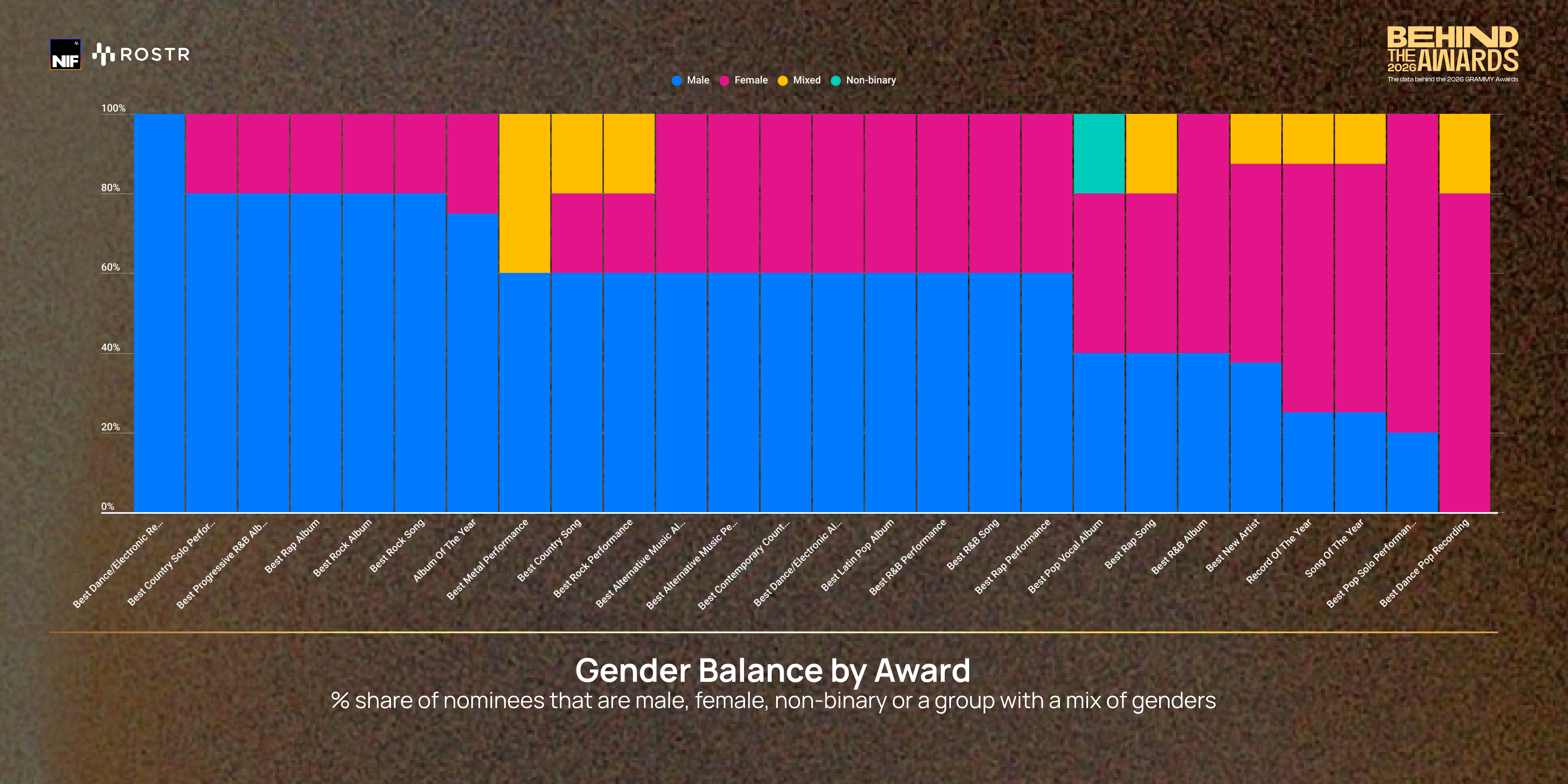
Gender share for each of the 26 awards. Ordered most male dominated (left) to most female dominated (right)

That’s it for this GRAMMY pass. We may come back again once the trophies are handed out if the winners throw up some good stories.

If you have artists up for a GRAMMY this year and want help getting them in front of the right people, drop us a line about For Your Consideration campaigns across The ROSTR Group – fyc@rostr.cc.

This is a guest post by Mark Williamson (CEO) and George Hanson (Head of Data) at The ROSTR Group (which owns and operates New Industry Focus). This is an independent analysis with no affiliation to the GRAMMY Awards.

For better or worse, the GRAMMYs are an annual snapshot of what's happening across the industry. Each year we use data from ROSTR to help understand the industry and data trends behind the year's nominees.

Coming up in this article…

  • Best New Artist is actually younger this year

  • UMG still lead, WMG step up, indies hold their ground

  • Management spreads out while agencies bunch together at the top

  • Gender balance tilts back towards men, with one first

⚠️ Read this first

We’ve focused again on 26 GRAMMY categories – the big general field awards and a set of mainstream genre categories. It’s a sample of the ballot, not every single category, but it gives a decent picture of what's happening behind the scenes. Read more about our methodology behind this analysis in our transparency block at the bottom.

Best New Artist: actually a bit new(er) this year

The Recording Academy defines Best New Artist around “breakthrough into the public consciousness.” In practice, that’s rarely a first‑or‑second‑release moment anymore. Last year, the average gap between a BNA nominee’s debut and their nomination was 7.8 years – a stat that went viral when we shared it on socials.

This year, that figure drops significantly to 5.4 years, the shortest average in three years. 2026's Best New Artist nominees are newer than they have been in a while.

The average number of years since first release for Best New Artist nominees since 2000 (pink line) plotted against the linear trend (blue line)

Here’s the 2026 field and roughly how long they’ve been releasing music:

  • The Marías – 8.1 years

  • Leon Thomas – 7.9

  • Olivia Dean – 6.1

  • Lola Young – 6.0

  • Addison Rae – 4.7

  • Alex Warren – 4.5

  • sombr – 4.2

  • KATSEYE – 1.4

While the average is down significantly this year, it's still well above the 2000s when Best New Artist nominees averaged just over 2 years from debut. It's not a coincidence that the sharp rise in the average coincides with the rise of streaming in the 2010s where it's taking longer for artists to breakthrough in a more competitive global market. Critics have argued the category should really be called “Best Breakthrough Artist,” and the numbers back that up.

The Major Labels: UMG still dominates, WMG pulls ahead of Sony

Across our 26 categories, UMG take 42% of all nominations, down from 50% last year. Independents stay steady at 23% (22% in 2025). WMG jump to 19% from 11%, while Sony's share drops slightly to 16% (from 17% LY).

Looking at unique artists instead of raw nominations:

  • UMG – 35% of nominated artists

  • Independents – 26%

  • WMG – 20%

  • Sony – 19%

UMG still have a clear lead, but WMG’s rise is interesting. In most of the datasets we’ve published over the last few years, they’ve been behind both UMG and Sony. This year they edge ahead of Sony on both nominations and artists and close a chunk of the distance to UMG.

Whether that’s early evidence of the company’s re‑tooling paying off or just one of those GRAMMY‑cycle quirks is a question for another day, but the chart doesn’t look like every other year we’ve run it.

(Left) Share of total nominations by label group
(Right) Share of unique artists nominated by label group

Zooming in on Best New Artist, Album of the Year and Record of the Year, UMG continue to stack up the nominations. Out of 25 total slots across those three categories, UMG take 1560% of the total.

The rest:

  • WMG – 4 nominations

  • Independents – 4

  • Sony – 2

That means independents outscore one of the majors (Sony) in the marquee categories for the first time since 2022, and only the ninth time since 2000.

This lines up with another report we published recently showing independents had a strong showing on this year's Coachella lineup.

The cumulative number of nominations across 3 major awards - BNA, AOTY, ROTY and broken down by the major label groups

Label Imprints: Interscope repeat, Atlantic have a strong year

Given UMG’s share, it’s no surprise their labels dominate the rankings again. Interscope once again top the rankings, but a notably strong year for Atlantic is a big part of why WMG have increased their share this year.

Top labels by total nominations this year:

  1. Interscope Records22 nominations / 11 artists

  2. Atlantic Records11 / 8

  3. Island Records10 / 4

  4. RCA Records9 / 5

  5. Capitol Records8 / 3

  6. Columbia Records8 / 4

  7. Def Jam Recordings6 / 3

  8. pgLang6 / 1

  9. EZMNY Records5 / 1

  10. Motown Records5 / 1

  11. Roadrunner Records5 / 1

  12. Warner Records UK5 / 3

For the first time in this run, two independent labels sneak into the top 10 by nominations – pgLang and EZMNY Records. But, it's important to note that both of those indies appear via co‑releases with majors: pgLang with Interscope, EZMNY with Motown. And both are thanks to one artist each – Kendrick Lamar & Leon Thomas.

(Left) The top 10 labels by total number of nominations
(Right) All labels sized by the share of nominations they received, color coded by label group

Management: the load spreads out

Last year, management was top‑heavy. Red Light alone had 13 nominations across 6 artists, with Good World on 9 and State of the Art on 8. This year the nominees are a little more spread out at the top.

⚠️ A reminder that these counts are only for the 26 mainstream categories we analyzed. For a full list of nominations by company check out the NIF & ROSTR Voter Guide.

Top management companies by total nominations:

  1. Artist Nation6 nominations / 1 artist

  2. Emagen Entertainment Group6 / 1

  3. Volara6 / 2

  4. pgLang6 / 1

  5. Red Light Management5 / 3

  6. 4 Strikes5 / 1

  7. Gold Theory5 / 1

  8. Culture Collective5 / 1

  9. Bieber Family Office4 / 1

  10. By The Way4 / 4

  11. Fly South Music Group4 / 1

  12. Goodlife Management4 / 2

  13. Habibi4 / 2

  14. Top Dawg Entertainment (TDE)4 / 2

  15. Full Stop Management - 3 / 3

As we've published in various reports before, the management world is fundamentally fragmented. Even Red Light, who have the largest management roster in the world with 500+ artists, have just 3 artists nominated across these 26 categories. Only a handful of other companies have more than 1 artist in the running.

The top 15 management companies based on total nominations
ⓘ When an artist is repped by multiple companies, we count that nomination for each company

Agencies: Wasserman’s jump, UTA’s surge

If management is spreading out, booking is doing the opposite.

Across our sample, the four major agencies – CAA, Wasserman, UTA, WME – now represent 85% of all nominations and 84% of nominated artists across these 26 categories. Last year those numbers were 75% and 70%.

The table this year:

  1. Wasserman Music51 nominations / 27 artists

  2. CAA38 / 22

  3. UTA33 / 20

  4. WME23 / 17

  5. IAG6 / 5

  6. Set Me Free Music4 / 2

  7. Supersonic Australasia3 / 2

  8. Primary Talent2 / 1
    9–18. A long tail of single‑nomination agencies.

This is a flip from 2025, when CAA led with 57 nominations and 24 artists, Wasserman sat on 35/19, and WME had 33/20.

The two big moves:

  • Wasserman swap places with CAA and add 16 represented nominations year‑on‑year.

  • UTA almost triple their total connected nominations (13 → 33) and more than double the number of nominated artists they represent in 2026 (8 → 20).

All booking agencies with at least 1 nomination
ⓘ When an artist is repped by multiple agencies, we count that nomination for each agency regardless of territory

Gender: the balance tips back

Last year we saw a rare near‑split across the 26 awards in this analysis: 50.5% of nominees were male, 48.2% were female, and mixed groups made up the rest. None of the artists in those categories publicly identified as non‑binary.

This year the balance slips back:

  • Male: 78 nominations55%

  • Female: 5438%

  • Mixed: 96%

  • Non‑binary: 1<1%

So we lose some of last year’s balance between men and women, but we see more mixed‑gender acts and the first non‑binary nominee in the set of categories we analyze.

The category‑level picture is familiar. In 2025, Album, Record and Song of the Year skewed heavily female, while Rap, Rock and Dance/Electronic albums were almost entirely male. That pattern doesn’t vanish in a single year, and you can see it in the updated chart, even as the overall share shifts.

Gender share for each of the 26 awards. Ordered most male dominated (left) to most female dominated (right)

That’s it for this GRAMMY pass. We may come back again once the trophies are handed out if the winners throw up some good stories.

If you have artists up for a GRAMMY this year and want help getting them in front of the right people, drop us a line about For Your Consideration campaigns across The ROSTR Group – fyc@rostr.cc.

This is a guest post by Mark Williamson (CEO) and George Hanson (Head of Data) at The ROSTR Group (which owns and operates New Industry Focus). This is an independent analysis with no affiliation to the GRAMMY Awards.

For better or worse, the GRAMMYs are an annual snapshot of what's happening across the industry. Each year we use data from ROSTR to help understand the industry and data trends behind the year's nominees.

Coming up in this article…

  • Best New Artist is actually younger this year

  • UMG still lead, WMG step up, indies hold their ground

  • Management spreads out while agencies bunch together at the top

  • Gender balance tilts back towards men, with one first

⚠️ Read this first

We’ve focused again on 26 GRAMMY categories – the big general field awards and a set of mainstream genre categories. It’s a sample of the ballot, not every single category, but it gives a decent picture of what's happening behind the scenes. Read more about our methodology behind this analysis in our transparency block at the bottom.

Best New Artist: actually a bit new(er) this year

The Recording Academy defines Best New Artist around “breakthrough into the public consciousness.” In practice, that’s rarely a first‑or‑second‑release moment anymore. Last year, the average gap between a BNA nominee’s debut and their nomination was 7.8 years – a stat that went viral when we shared it on socials.

This year, that figure drops significantly to 5.4 years, the shortest average in three years. 2026's Best New Artist nominees are newer than they have been in a while.

The average number of years since first release for Best New Artist nominees since 2000 (pink line) plotted against the linear trend (blue line)

Here’s the 2026 field and roughly how long they’ve been releasing music:

  • The Marías – 8.1 years

  • Leon Thomas – 7.9

  • Olivia Dean – 6.1

  • Lola Young – 6.0

  • Addison Rae – 4.7

  • Alex Warren – 4.5

  • sombr – 4.2

  • KATSEYE – 1.4

While the average is down significantly this year, it's still well above the 2000s when Best New Artist nominees averaged just over 2 years from debut. It's not a coincidence that the sharp rise in the average coincides with the rise of streaming in the 2010s where it's taking longer for artists to breakthrough in a more competitive global market. Critics have argued the category should really be called “Best Breakthrough Artist,” and the numbers back that up.

The Major Labels: UMG still dominates, WMG pulls ahead of Sony

Across our 26 categories, UMG take 42% of all nominations, down from 50% last year. Independents stay steady at 23% (22% in 2025). WMG jump to 19% from 11%, while Sony's share drops slightly to 16% (from 17% LY).

Looking at unique artists instead of raw nominations:

  • UMG – 35% of nominated artists

  • Independents – 26%

  • WMG – 20%

  • Sony – 19%

UMG still have a clear lead, but WMG’s rise is interesting. In most of the datasets we’ve published over the last few years, they’ve been behind both UMG and Sony. This year they edge ahead of Sony on both nominations and artists and close a chunk of the distance to UMG.

Whether that’s early evidence of the company’s re‑tooling paying off or just one of those GRAMMY‑cycle quirks is a question for another day, but the chart doesn’t look like every other year we’ve run it.

(Left) Share of total nominations by label group
(Right) Share of unique artists nominated by label group

Zooming in on Best New Artist, Album of the Year and Record of the Year, UMG continue to stack up the nominations. Out of 25 total slots across those three categories, UMG take 1560% of the total.

The rest:

  • WMG – 4 nominations

  • Independents – 4

  • Sony – 2

That means independents outscore one of the majors (Sony) in the marquee categories for the first time since 2022, and only the ninth time since 2000.

This lines up with another report we published recently showing independents had a strong showing on this year's Coachella lineup.

The cumulative number of nominations across 3 major awards - BNA, AOTY, ROTY and broken down by the major label groups

Label Imprints: Interscope repeat, Atlantic have a strong year

Given UMG’s share, it’s no surprise their labels dominate the rankings again. Interscope once again top the rankings, but a notably strong year for Atlantic is a big part of why WMG have increased their share this year.

Top labels by total nominations this year:

  1. Interscope Records22 nominations / 11 artists

  2. Atlantic Records11 / 8

  3. Island Records10 / 4

  4. RCA Records9 / 5

  5. Capitol Records8 / 3

  6. Columbia Records8 / 4

  7. Def Jam Recordings6 / 3

  8. pgLang6 / 1

  9. EZMNY Records5 / 1

  10. Motown Records5 / 1

  11. Roadrunner Records5 / 1

  12. Warner Records UK5 / 3

For the first time in this run, two independent labels sneak into the top 10 by nominations – pgLang and EZMNY Records. But, it's important to note that both of those indies appear via co‑releases with majors: pgLang with Interscope, EZMNY with Motown. And both are thanks to one artist each – Kendrick Lamar & Leon Thomas.

(Left) The top 10 labels by total number of nominations
(Right) All labels sized by the share of nominations they received, color coded by label group

Management: the load spreads out

Last year, management was top‑heavy. Red Light alone had 13 nominations across 6 artists, with Good World on 9 and State of the Art on 8. This year the nominees are a little more spread out at the top.

⚠️ A reminder that these counts are only for the 26 mainstream categories we analyzed. For a full list of nominations by company check out the NIF & ROSTR Voter Guide.

Top management companies by total nominations:

  1. Artist Nation6 nominations / 1 artist

  2. Emagen Entertainment Group6 / 1

  3. Volara6 / 2

  4. pgLang6 / 1

  5. Red Light Management5 / 3

  6. 4 Strikes5 / 1

  7. Gold Theory5 / 1

  8. Culture Collective5 / 1

  9. Bieber Family Office4 / 1

  10. By The Way4 / 4

  11. Fly South Music Group4 / 1

  12. Goodlife Management4 / 2

  13. Habibi4 / 2

  14. Top Dawg Entertainment (TDE)4 / 2

  15. Full Stop Management - 3 / 3

As we've published in various reports before, the management world is fundamentally fragmented. Even Red Light, who have the largest management roster in the world with 500+ artists, have just 3 artists nominated across these 26 categories. Only a handful of other companies have more than 1 artist in the running.

The top 15 management companies based on total nominations
ⓘ When an artist is repped by multiple companies, we count that nomination for each company

Agencies: Wasserman’s jump, UTA’s surge

If management is spreading out, booking is doing the opposite.

Across our sample, the four major agencies – CAA, Wasserman, UTA, WME – now represent 85% of all nominations and 84% of nominated artists across these 26 categories. Last year those numbers were 75% and 70%.

The table this year:

  1. Wasserman Music51 nominations / 27 artists

  2. CAA38 / 22

  3. UTA33 / 20

  4. WME23 / 17

  5. IAG6 / 5

  6. Set Me Free Music4 / 2

  7. Supersonic Australasia3 / 2

  8. Primary Talent2 / 1
    9–18. A long tail of single‑nomination agencies.

This is a flip from 2025, when CAA led with 57 nominations and 24 artists, Wasserman sat on 35/19, and WME had 33/20.

The two big moves:

  • Wasserman swap places with CAA and add 16 represented nominations year‑on‑year.

  • UTA almost triple their total connected nominations (13 → 33) and more than double the number of nominated artists they represent in 2026 (8 → 20).

All booking agencies with at least 1 nomination
ⓘ When an artist is repped by multiple agencies, we count that nomination for each agency regardless of territory

Gender: the balance tips back

Last year we saw a rare near‑split across the 26 awards in this analysis: 50.5% of nominees were male, 48.2% were female, and mixed groups made up the rest. None of the artists in those categories publicly identified as non‑binary.

This year the balance slips back:

  • Male: 78 nominations55%

  • Female: 5438%

  • Mixed: 96%

  • Non‑binary: 1<1%

So we lose some of last year’s balance between men and women, but we see more mixed‑gender acts and the first non‑binary nominee in the set of categories we analyze.

The category‑level picture is familiar. In 2025, Album, Record and Song of the Year skewed heavily female, while Rap, Rock and Dance/Electronic albums were almost entirely male. That pattern doesn’t vanish in a single year, and you can see it in the updated chart, even as the overall share shifts.

Gender share for each of the 26 awards. Ordered most male dominated (left) to most female dominated (right)

That’s it for this GRAMMY pass. We may come back again once the trophies are handed out if the winners throw up some good stories.

If you have artists up for a GRAMMY this year and want help getting them in front of the right people, drop us a line about For Your Consideration campaigns across The ROSTR Group – fyc@rostr.cc.

👋 Disclosures & Transparency Block

In order to produce a cohesive report we’ve narrowed down the scope of our GRAMMY analysis to 26 award categories. How we selected those categories is detailed below. This means that this analysis is not the full picture but we believe it’s a representative picture for our particular audience.

Category Selection

To provide insights into the most prominent GRAMMY categories, we selected a focused list of awards, emphasizing popularity and broad industry impact.

General Field
We prioritized non-genre-specific categories that typically feature at the end of the telecast, such as Record of the Year and Album of the Year.

Genre-Specific Categories
For major genres, we selected 2-4 categories each in Alternative, Country, Dance/Electronic, Metal, Pop, R&B, Rap, and Rock. To ensure inclusivity, we also included a Latin category, specifically Latin Pop, recognizing that the Latin GRAMMYs are a distinct event deserving separate analysis.

Note on Category Focus
Our selected categories primarily cover album, recording, performance, and song awards. While “song” categories officially honor songwriters and composers, for simplicity, we track these nominations at the artist level, acknowledging the essential role artists play in securing these nominations, regardless of the formal recipient.

Tracking Methodology: Companies Representing Nominees

For a (near) complete view of industry representation, we identified key management, label, and agency affiliations associated with each nominee.

Management Companies
Each artist’s management company is credited for nominations. For collaborative nominations, each artist’s management receives recognition.

Record Labels
The label that released the nominated work is credited for each nomination. In cases of featured artists, only the primary artist’s label is tracked. For artists associated with multiple labels (e.g., Jacob Collier’s releases through Decca and Interscope), both labels are credited. For joint releases by artists on different labels (e.g., Future & Metro Boomin), each label listed in the release’s official byline is credited.

Agencies
Agencies are credited in the same way as management companies, with each artist’s agency counted for individual and collaborative nominations (regardless of booking territory).

Categories We Tracked

Album of the Year

Best Alternative Album

Best Alternative Music Performance

Best Country Album

Best Country Solo Performance

Best Country Song

Best Dance/Electronic Album

Best Dance/Electronic Recording

Best Latin Pop Album

Best Metal Performance

Best New Artist

Best Pop Album

Best Pop Dance Recording

Best Pop Solo Performance

Best Progressive R&B Album

Best R&B Album

Best R&B Performance

Best R&B Song

Best Rap Album

Best Rap Performance

Best Rap Song

Best Rock Album

Best Rock Performance

Best Rock Song

Record of the Year

Song of the Year

📨 Subscribe to NIF

Get news dropped in your inbox 👇

📨 Subscribe to NIF

Get news dropped in your inbox 👇

Related Articles